Article
24 Jul 2026
(NOT) LOST IN TRANSLATION EPISODE 1: Barbaras Bier Haus
How Barbara’s Bier Haus turned Bavaria into a distinctly British night out concept through branding, food and entertainment.

Business ideas and concepts often cross borders easier than they cross cultures.
The difference usually isn’t the quality of the original concept. It’s how well it’s translated for a different market.
Operators often feel the need to stamp an “authentic” or “traditional” label on a concept, but authenticity alone rarely leads to mass-market adoption in a new country.
This series looks at international concepts that have been brought to the UK, exploring what changed, what stayed the same and, most importantly, why they work(or don’t).
Barbara’s Bier Haus seemed like the perfect place to start.
———
Last Friday evening, I found myself standing in a queue outside Barbara’s Bier Haus in Bournemouth. That caught my attention before I had even entered. Bournemouth has no shortage of places to drink, and on a busy stretch of Old Christchurch Road there is rarely a compelling reason to wait outside one venue when another is only a few doors away.
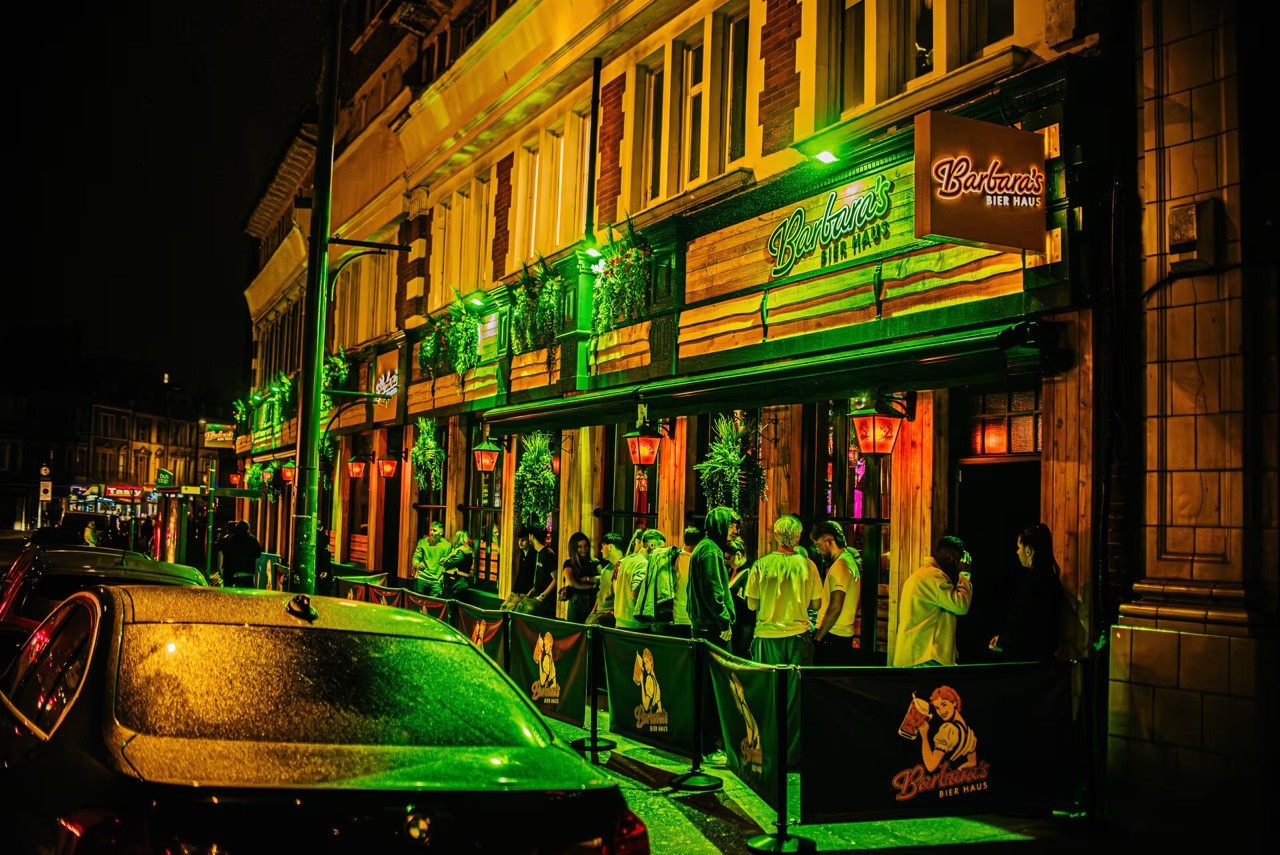
Yet people were waiting.
Most people know me as the Greek guy living in Britain, but my grandmother was German and I spent a large part of my childhood around Munich and Bavaria. I therefore arrived with expectations, although perhaps more personal ones than most of the people in the queue. In my mind, I was walking into a modern German beer hall: good beer, long tables, traditional food and perhaps live music pitched towards a younger crowd.
What I found was harder to categorise.
Barbara’s is part nightclub, part cocktail bar, part sports venue and part late-night karaoke destination. It offered beer towers, bottomless brunches, pizzas, and the sort of group drinking equipment that turns ordering a round into a minor piece of theatre. Yet despite all of that, it remained recognisably attached to the imagery of the Bavarian beer hall and Alpine ski lodge.
For the first 20 minutes, I was less interested in behaving like a customer than watching everybody else. I noticed where people looked as they entered, what they ordered first, what they photographed or filmed with their phones and how groups moved through the room. It is an occupational hazard. I struggle to switch off when I enter a business that feels familiar and strange at the same time.
The longer I stayed, the more obvious its central trick became. Barbara’s had retained enough of Bavaria to establish an identity, while rebuilding the evening around the way British people already socialise.
From Heidi to Barbara
Barbara’s emerged after Rekom UK entered administration and its British business separated from the Danish Rekom Group. Pub & Bar reported in May 2024 that the newly formed NEOS Hospitality had taken over a 24-venue estate that included Heidi’s Bier Bar, Proud Mary and Bar & Beyond. Propel later confirmed that two of those venues, in Cardiff and Birmingham, traded as Heidi’s.
In September 2024, Propel reported that NEOS had secured £25 million to expand its party-bar business and launch Barbara’s Bier Haus alongside Bonnie Rogues. The same report noted that the Heidi’s name belonged to the former Danish parent group. The investment made clear that Barbara’s was intended to become a repeatable national format, rather than a cosmetic rebrand of two inherited bars.
The change from Heidi to Barbara may appear small, but it contains much of the concept’s wider logic.
In The Founder, Ray Kroc’s character explains why copying the McDonald brothers’ restaurant system would never have been enough. The name mattered. McDonald’s, he says, “sounds like America”.
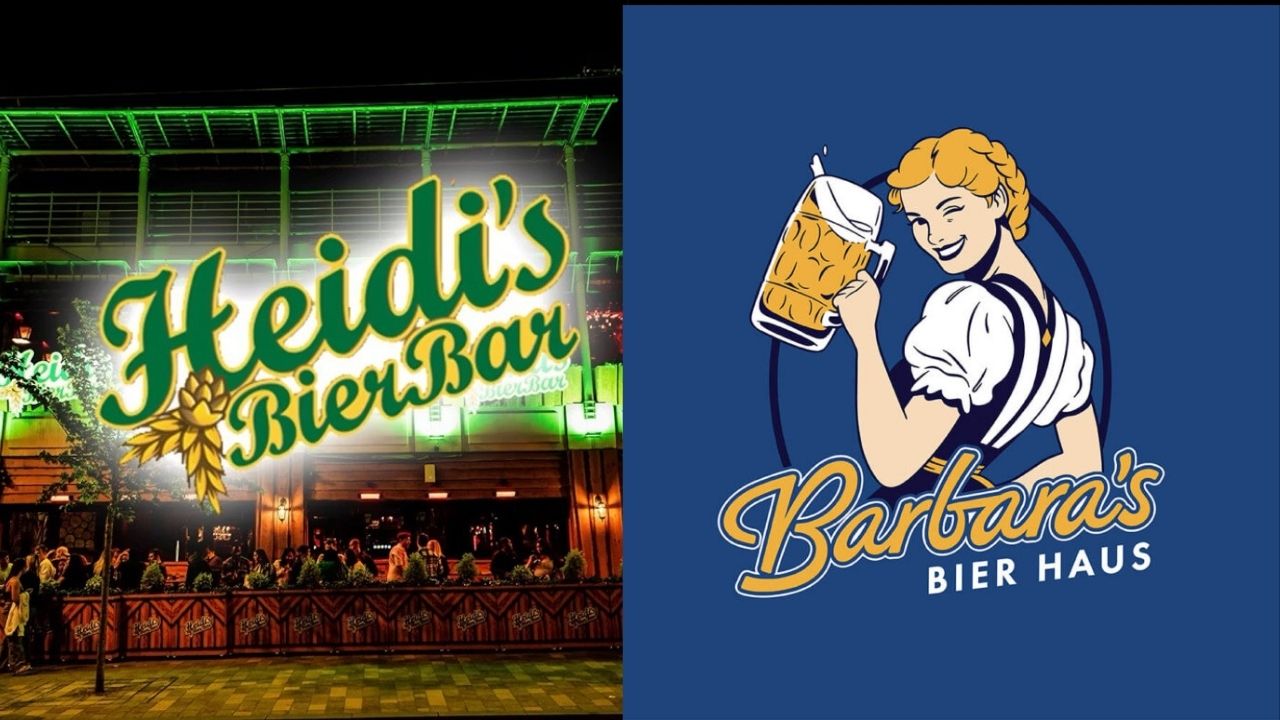
Heidi is not merely a German first name. To a British audience, it carries a ready-made set of associations with the Alps, mountain villages and the famous Swiss children’s story. It sounds imported before anything else has been explained. Barbara, although certainly used in Germany and elsewhere, feels more familiar within everyday British life. She might be a colleague, an aunt, a neighbour or the organiser of a particularly ambitious work night out.
The business has used that familiarity deliberately. Its current language treats Barbara as a host with opinions, favourites and house rules. Happy-hour copy tells customers that “Barbara insists one hour isn’t enough”. The brunch pages explain that “Barbara would never leave brunch to chance”. Customers are invited to become “a friend of Barbara”, while the venue is repeatedly described as Barbara’s “Haus”.
The result is less like an anonymous themed bar and more like entering the exaggerated world of a fictional landlady. The German spelling of “Bier Haus” keeps the imported character. The first name makes it easier to approach.
From a marketing perspective, this is where the name earns its keep. Barbara is able to speak across advertising, social media, menus and the venue itself, giving the business a recognisable personality without having to explain the joke every time.
A business model built for the whole day and night
The Bournemouth venue took the concept beyond the conversion of inherited Heidi’s sites. NEOS acquired the former Revolution premises on Old Christchurch Road and announced a £1.5 million refurbishment, with Barbara’s scheduled to open at the end of March 2025. Trade coverage described it as one of the operator’s core brands and an après-ski-themed party bar.
The former Revolution unit gave NEOS a large city-centre space with a history of late-night trading. Rather than attempt to create a traditional restaurant or beer hall, the company installed a concept capable of using the building from the afternoon until 3am. Barbara’s Bournemouth currently advertises opening hours extending to 3am every day, including a noon opening on Saturdays.
Bournemouth is one example of a model repeated across the wider chain. Opening hours and events vary between cities, but the commercial logic remains consistent: use food, sport, group bookings and entertainment to give the same venue several reasons to be busy across the day, the week and late into the night.
This matters because the economics of a large hospitality site depend on the number of viable reasons people have to enter it. A venue devoted entirely to German beer would speak to a narrower occasion. Barbara’s can host sport, early drinks, food, birthdays, brunches, student nights, karaoke, live music and late-night dancing without appearing to abandon its identity.
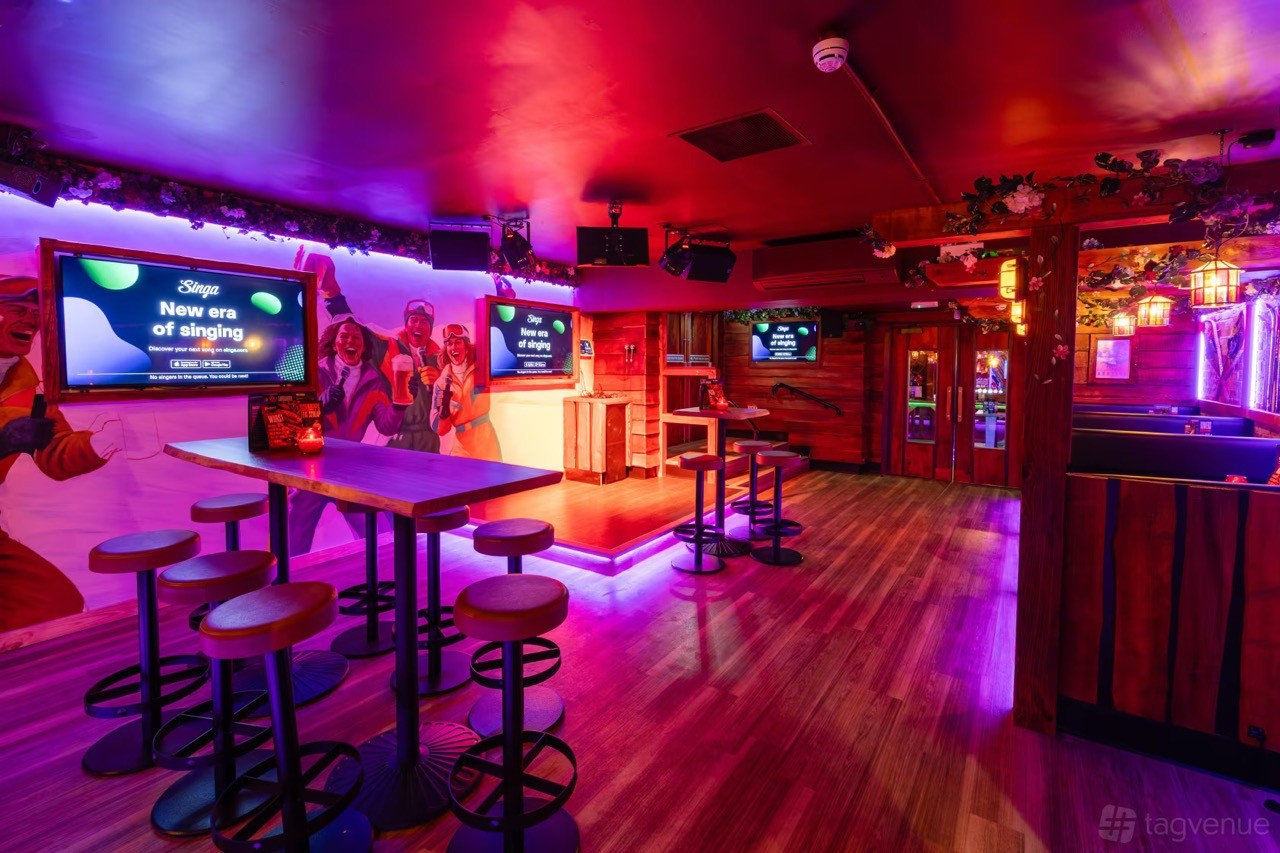
NEOS describes the brand as a “Bavarian basecamp” capturing the best parts of an après-ski bar, allowing customers to experience them without being anywhere near the mountains. That wording is revealing. It avoids promising a faithful reproduction of Bavaria. It promises a collection of its most enjoyable and exportable parts.
Après-ski is especially useful because it is already a hybrid. It belongs to Alpine tourism, but its modern imagery has travelled far beyond Germany or Austria. It suggests beer, music, ski clothes, communal celebration and a disregard for what time the last run finished. A customer does not need to know anything about Bavarian traditions to understand the emotional proposition.
Germany, edited for the British appetite
The menu provides perhaps the clearest evidence of how carefully Barbara’s has selected what to import.
A restaurant pursuing conventional Bavarian authenticity might offer pork knuckle, weisswurst, schnitzel, sauerkraut, käsespätzle, obatzda or regional dumplings. These dishes can be excellent, but many require explanation, create kitchen complexity or sit awkwardly within a venue whose busiest trading hours arrive late at night.
Barbara’s takes another route. Its food menu is built around familiar British bar formats carrying a Bavarian accent. Customers encounter a foot-long Bratwurst XXL, classic and cheese frankfurters, giant pretzels with cheese dip and two-foot pizzas made for sharing. Even the pizza is themed as Bavarian, topped with sliced frankfurters, crème fraîche and red onion chutney. The venue describes the range simply as an “après food menu”.
The footlong sausage is the perfect example. Bratwurst supplies the German reference, while the footlong hot-dog format is already understood in Britain. It arrives without the customer needing to identify a regional sausage style or negotiate an unfamiliar dining ritual. The same applies to the giant pretzel. It looks good in a group, is easy to photograph, carries immediate Alpine associations and requires no explanation from the staff.
The menu does not ask British customers to develop new habits. It gives their existing habits a costume.
That restraint continues across the drinks offer. Barbara’s promotes steins, beer towers, cocktail towers, ski shots and schnapps-based serves alongside familiar cocktails and widely recognised beer brands. The German and Alpine elements provide novelty, while mainstream options reduce the risk that one cautious member of a group vetoes the venue. The official cocktail range includes a “Schnapps Stick” and “Largeritta” beside mojitos, palomas, espresso martinis and other established favourites.
The imported element is therefore less about individual recipes than rituals.
A stein makes the beer feel on theme even when the act of ordering it remains the same. A shot ski turns an Alpine object into a group drinking game. A beer tower makes volume visible and communal. The drink becomes entertainment before anybody has tasted it.
These products also do part of the marketing themselves. A normal round of drinks might pass without evidence. A group attempting a shot ski almost always produces a phone camera.
This is where Barbara’s departs most sharply from the traditional beer hall. In Bavaria beer customs have social meaning because they belong to daily life and regional history. In the venues, those objects must work harder. They have to create photographs, prompt group participation and help Barbara’s distinguish itself from the drinking pub next door.
Keeping Bavaria in the room
The room still needs to make the proposition believable. Without the Alpine references, the menu would resemble that of almost any large British late-night bar.
The space does most of the explaining. Timber, old artwork, skis, chalet details, oversized drinking vessels and visual references to mountain life establish the setting before the customer studies the menu. NEOS has described the concept in terms of chalet-style interiors, ski-lift photo booths, live music and themed nights. A planned London site has been described as including dancing bartenders, ski shots, beer towers and a gondola photo booth.
This is experiential marketing in a practical sense. Customers do not encounter the brand through one campaign or logo. They encounter it repeatedly through the room, the staff, the menu and the way drinks arrive at the table.

None of these details has to be culturally exact. Together, they create immediate recognition.
This is why the idea avoids feeling entirely cynical. The room does not mock Bavarian culture or reduce Germany to a collection of crude national stereotypes. It takes pleasure in the visual language of Alpine hospitality. The scale of the steins, the communal seating and the abundance of timber carry a genuine warmth.
As somebody who spent time around Munich growing up, I did not feel that the venue was laughing at Bavaria. It was borrowing from a culture associated with generosity, communal drinking and celebration, then passing those qualities through the machinery of a British night out. It preserved the emotional memory while changing the practical details.
What it left behind
This is the strong point. The strongest international concepts are often revealed by what they decline to import.
Barbara’s did not bring over the slower pace of a traditional bier haus. It did not require beer to remain the central attraction throughout the evening. It did not depend on customers arriving for a full meal, understanding regional customs or spending several hours seated at one table.
Customers can watch sport, order a cocktail, eat a pizza, sing karaoke and continue into a nightclub atmosphere without changing location. The weekly programme stretches across quizzes, music bingo, student events, themed Thursdays, weekend parties and Ski Sundays.
This answers a very British group problem: everybody wants a slightly different evening.
One person wants beer. Another wants cocktails. Somebody wants to eat. Somebody wants to watch the match. Later, someone will suggest dancing. A specialist beer hall forces the group to agree on the same experience. Barbara’s gives them several experiences under one roof.
That variety also makes the concept commercially useful to its operator. The same square footage can serve several audiences across a long trading day. Happy hour encourages earlier visits. Food and sport create reasons to arrive before late-night trading. Towers and group packages increase the value of shared occasions. Entertainment creates reasons to return when customers have already seen the décor.
Those conclusions are commercial inferences from the venue’s programme rather than figures released by NEOS. The company has not publicly disclosed Barbara’s average spend, dwell time or site-level profitability. Still, the operating logic is visible from the timetable.
The people behind the Haus
Barbara’s came to life through NEOS Hospitality, although the success of the brand involved a much wider creative team. Keane has described its contribution as brand work and experience strategy, with the visual language later appearing across interiors, social media, communications and staff merchandise.
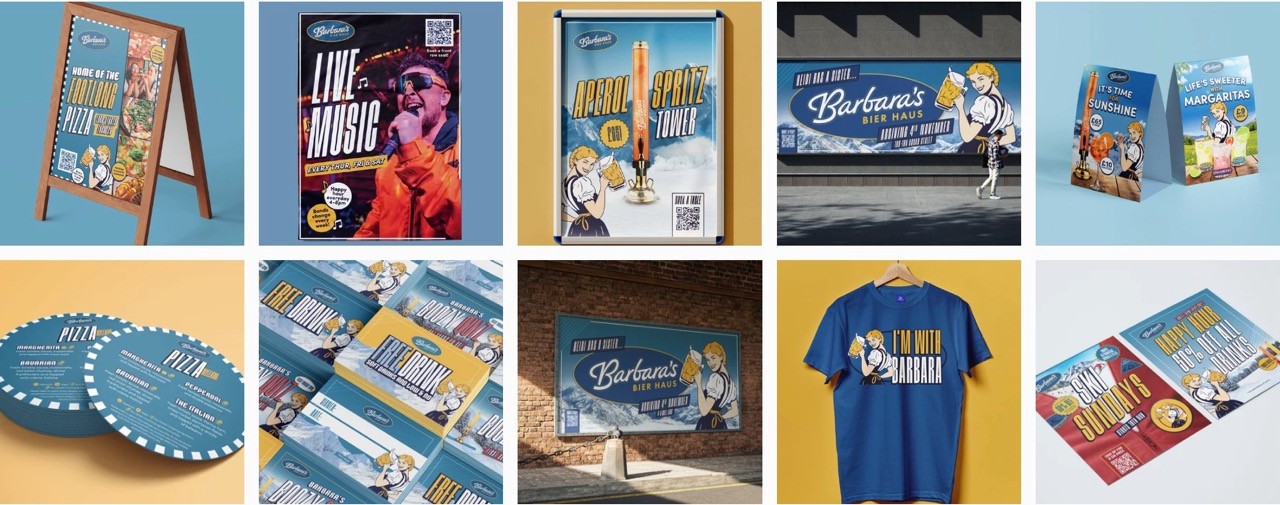
Hospitality consultancy Keane worked on the early brand and experience strategy. In Charly Westcott’s own project case study, she explains that she worked with Keane and the wider NEOS in-house design team to extend the established logo, colour palette and initial direction across menus, uniforms, merchandise, glassware, advertising, social media and the venues themselves.
Studiose joined later. Its Barbara’s case study explains that the brand was already established before it carried out an audit and refined the vision, mission, values, personality, tone of voice and internal guidance.
The result is a brand that feels coherent because every discipline has played its part. The commercial team gave it room to grow, the creative work made it recognisable, the operational teams made it deliverable, and the brand work gave Barbara a voice customers could remember. Together, they turned a fictional host into a name people recognise across every venue.
From two inherited sites to a growing chain
Barbara’s began with the conversion of the two inherited Heidi’s venues in Cardiff and Birmingham. FOR Cardiff documented the Cardiff transition in November 2024, while Pub & Bar later reported the Bournemouth and Bristol openings. Brighton followed, and Barbara’s official website now lists Southampton as its sixth operating location.
That expansion is the point. What began as a response to two inherited venues has become one of NEOS Hospitality’s core concepts. Pub & Bar described Barbara’s as an experience-led format built around entertainment, interactive elements and themed design, rather than a straightforward bar rebrand.
Back outside
When I left Barbara’s several hours later, even more people were still waiting outside. It was 1 AM and I doubt that massive queue even made it to the door by the time the venue closed.
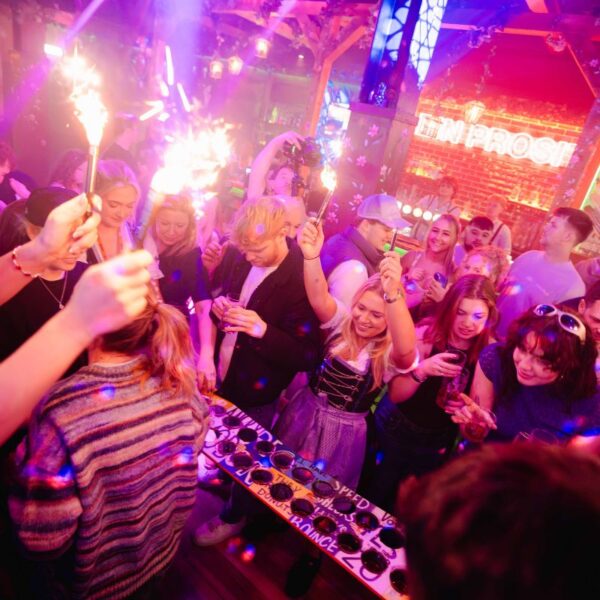
Most were probably not considering the history of Rekom UK, the economics of large licensed venues or the careful reduction of Bavarian cuisine into bratwurst, pretzels and steins. They were looking for somewhere busy, entertaining and slightly different from the places they already knew.
That is why the translation works.
Barbara’s shows that hospitality marketing works best when the venue gives people a story worth repeating. Social media can spread that story, but the experience has to create it first.
Barbara’s has not imported Germany in full. It has imported the parts that travel easily: communal drinking, abundant beer, Alpine warmth, playful ceremony and the permission to become louder than usual. It has then placed them inside a British late-night format built around choice, movement and group entertainment.
Even the change from Heidi to Barbara follows the same pattern. The original name announced the Alps. The new one introduces a person. “Bier Haus” establishes the foreign setting, while “Barbara’s” makes the invitation feel local.
A purist could point to everything missing: the regional food, the traditions, the pace, the cultural depth. They would be correct, but they would miss what the business is trying to achieve. Barbara’s is not a museum of Bavarian life. It is a British party bar using Bavaria as its creative source material.
The distinction matters because international ideas rarely succeed through complete imitation. They succeed when somebody identifies which parts carry meaning and which parts merely belong to the place where the idea began.
Barbara’s kept the steins, the skis and the sense of collective celebration.
Britain supplied the cocktails, karaoke, sport, bottomless brunch and 3am finish.
And between the two, queues formed…
———
Were you involved in bringing Barbara’s Bier Haus to life?
I would be interested to hear more about the thinking behind the concept, what changed during its development and what the team has learned as Barbara’s has expanded across the UK.
I am also looking for the next international concept to examine as part of (Not) Lost in Translation series. Suggestions, introductions and stories are welcome.
———
About Thanos G Zeppos
Thanos G Zeppos is co-founder of BRINQQ, a UK marketing agency working with hospitality, retail and other customer-facing businesses. His work looks at how branding, customer behaviour and marketing decisions influence footfall, bookings and sales.
———
Have a project in mind?
Whether you are developing a new concept, refreshing an existing brand or planning your next campaign, BRINQQ can help bring the project to life.
We work collaboratively across branding, content, campaigns and launch support, joining the right people at the right stage of the process.